

Dear Colleagues:
Every few weeks during the summer, a predictable, though demonstrably false, headline pops up at news outlets across the country: “Local Shelter Overcrowded and Forced to Euthanize [sic] Animals.” The accompanying article typically features the pound manager offering soundbites about too many animals, and the need for spay/neuter. To the average reader, the news story appears uncontroversial, obvious. And, of course, fewer animals and more sterilization would be better. But when it comes to shelters, it represents one of the most persistent failures of municipal journalism. And animals are paying the price.
The central problem is that local and national news outlets don’t treat press releases by animal shelter managers as claims to be investigated. Instead, they treat them as facts to be transcribed. When a municipal agency states that it has “run out of room,” reporters routinely accept the premise without asking how that room is managed, what programs are being implemented, or whether lives are being sacrificed to uncaring and convenience.
When they do interview others, it is usually a group that parrots the shelter’s narrative. The articles basically write themselves. Or, more accurately, they are pre-written, with the insertion here and there of a quote from someone that offers little more than pound-killing apologia.
But there is one thing that usually disproves the narrative: the numbers. However, that requires reporters to actually add two and two together, which they seldom do. For example, when the New York Times wrote a piece on “surging intakes” at the city pound leading to greater killing, a simple search of the pound’s website would have demonstrated that intakes remained well below pre-pandemic levels, and were among the lowest since their inception: 24% fewer dogs and 29% fewer cats. It is a search the reporters at the nation’s venerable newspaper failed to do.
When the Los Angeles Times recently published an article that cat killing is up a staggering 32% at the L.A. city pound, that kitten killing has increased even more, and that even dog killing is up, and blamed a lack of spay/neuter, the numbers there also proved otherwise:
Dog intakes have declined by 13% compared to pre-pandemic levels (2025 vs. 2018), but dog killing is up roughly 30% in that same period. Comparing year-to-date dog intakes and killings with the same period last year, dog intake declined 6%, but pound staff killed 2% more dogs. And it isn’t just dogs. Kitten intake actually went down by 14% compared to pre-pandemic levels, but killing increased 40%.
That’s not open to interpretation. It’s just math.
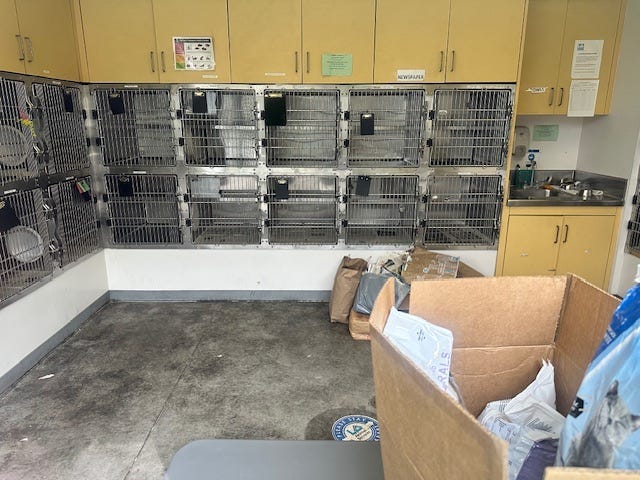
Apologists for pound killing tend to respond similarly: when a shelter director claims a facility is “full,” that’s just math, too, they say: 50 cages, 50 cats, 0 kennels left. But many of these facilities are not full. Los Angeles City shelters, for example, keep cages empty, including entire cat rooms, despite killing more cats. Did L.A. Times reporters walk through the facility before writing a piece blaming a rise in cat killing on lack of spay/neuter? Of course not.
Moreover, physical cages inside a brick-and-mortar building represent only a percentage of a community’s actual capacity. When I ran shelters, roughly one in four animals spent some time in foster care. Today’s high performing shelters have even higher rates. How many animals are in foster care? And, just as crucially, if someone offers to foster, how quickly can they start doing so? Reporters do not ask.
The same is true of rescuing. A non-profit rescue group offered to pull dogs on the kill list at the Los Angeles County Department of Animal Care & Control, but they were told approval would take nine months. Not nine hours, nine days, or nine weeks — nine months. Where is the urgency given that dogs are currently on death row and staring down oblivion today? Nine months of killing dogs, while bureaucrats — making hundreds of thousands per year and in the case of the General Manager, total compensation and benefits exceeding $568,000 per year — cannot be bothered to process an application to become an adoption partner in a timely manner.
There are other questions that reporters should ask, such as about the type of safety net programs that organization has to help people overcome the medical, behavioral, and environmental conditions that cause them to surrender animals. Questions about how effective the pound is at reuniting strays with families missing animals so that animals with homes do not compete for kennel space with those who do not have one. Questions about adoption hours and protocols. In some communities, comparatively lower adoption numbers are a result of post-pandemic changes in shelter policy, including reduced adoption hours, appointment requirements, cumbersome visiting procedures, and a refusal to return phone calls from people interested in adopting. The pound director running such a “shelter” cannot have it both ways. They cannot discourage adoptions post-pandemic while lamenting fewer adoptions compared to prior years when those procedures were not in place. But that is exactly what they try to do — and lazy reporters are letting them get away with it.
To cover animal welfare accurately, journalists must stop acting as PR agencies for shelter executives. They must treat municipal shelters like any other public agency, applying basic scrutiny. But this is easier said than done. I recently spent hours with one such reporter who called to discuss whether something else was going on inside New York City’s “shelters” aside from their talking points of more people surrendering (a lie) and fewer people adopting (true, but not for want of trying only to be stymied by cumbersome and inept agency procedures). We talked about all the things I’ve outlined here and more, but the story never ran because his editors killed it. When I followed up with him, I was told that they thought it was too critical. It seems some newspapers don’t just act as PR agencies by default: they’ve made it policy. This keeps the false narrative intact.
But when journalists start acting like journalists and shift from stenography to investigation, that narrative changes entirely. And instead of running headlines that blame the public or normalize animal destruction as an inevitable tragedy, they would expose managerial failures, policy bottlenecks, and bureaucratic indifference.

And then, voters and taxpayers can start holding those who run these facilities, and the elected and appointed officials who are supposed to oversee them but look the other way, accountable. Until that happens — to paraphrase the Washington Post — animals die in darkness.
For the animals,
Nathan Winograd
Executive Director