

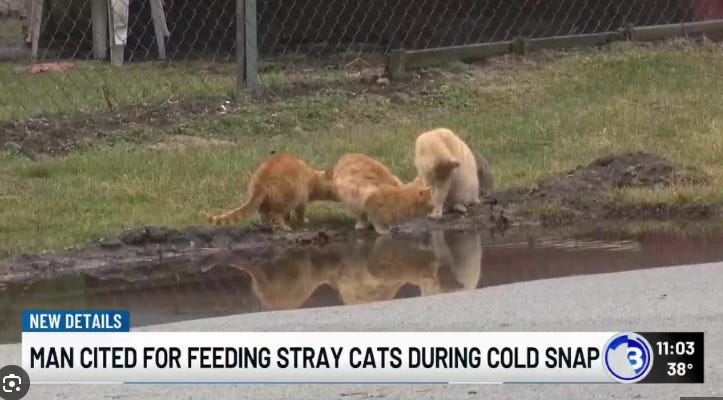
An Ohio man “was cited for feeding stray cats behind a building he owns during a recent stretch of harsh winter weather.”
“He said many feral cats live in the alley behind the property” and “began feeding the cats and providing shelter during the recent winter weather.”
[T]he cops went nuts and were like, ‘You’re feeding cats? Oh my God, you can’t do that, that’s against a village ordinance.’ They came out immediately and wrote me up…”
“I was cited a $100 court cost. [The] Judge was as surprised as I was that you can’t feed cats…
“They literally were going to starve to death, or freeze to death, or dehydrate. And so, we put out those things just enough to get them through that cold snap and that deep snow.”
The ordinance criminalizes compassion and works at cross purposes with the claimed goals of officials.
A community cat program reduces intakes and killing of community cats, decreases complaint calls to animal control, reduces illness in the shelter, and reduces wasteful spending of taxpayer money. It increases opportunities to expand lifesaving efforts for other animals, such as dogs. It also empowers, rather than punishes, Good Samaritans.
If enacted in Ohio and elsewhere, it would also allow police to go “nuts” over real crimes, not because residents care for needy cats.
The No Kill Advocacy Center has model legislation for individuals seeking to enact a community cat program law in their city, county, or state.